
Measuring Progress Through Self-Compassion
“I’m measuring progress by how gently I treat myself on hard days.”
I saw a post about this recently, and it stayed with me all week. Compassion comes easily when someone we love is struggling, but with ourselves, it often feels impossible. This is something I have struggled with throughout my health journey, especially on the hard days. In these ruts, I find it difficult to offer myself the same care and support I would naturally give a friend. Over the past year, I set an intention to strengthen my relationship with self-compassion. I took a course on it, and it helped me see how important the way we speak to ourselves truly is. The language we use each day shapes how our body and nervous system feel. Non-judgmental communication with our body is where our power and freedom lie.
💜 What is Self-Compassion?
Self-compassion is how we relate to ourselves in times of struggle, failure, or stress. Kristin Neff, a leading researcher, breaks it down into three core components:
Self-Kindness: Responding to difficulty with care and warmth instead of harsh judgment. Example for dancers: Instead of thinking, “I messed up that combination, I’m terrible,” you might reframe it to, “That was challenging today, but I’ll do my best again next time.”
Common Humanity: Recognizing that struggle is part of the human experience, not a personal flaw. Example for dancers: “Everyone misses a step or feels tired. You’re not alone in this.”
Mindfulness: Holding your experience in balanced awareness, without exaggerating or suppressing it. Example for dancers: Not ruminating over a mistake or trying to push it away, instead just notice, “I feel frustrated, and that’s okay.”
For dancers, self-compassion might mean treating yourself with the same care, patience, and understanding you would offer a close friend, even when your training feels exhausting, a performance doesn’t go as planned, or life outside the studio feels overwhelming. This could also look like noticing when your muscles are fatigued and allowing a rest rather than pushing through, or speaking kindly to yourself after a misstep instead of ruminating on it. Self-compassion is about acknowledging your struggles without judgment, giving yourself permission to pause, and responding in ways that support both your body and mind.
For women, self-compassion also includes recognizing the cumulative demands of daily life, hormonal changes, and emotional energy, while giving yourself the same care you freely offer others. Ultimately, self-compassion isn’t weakness or indulgence. It is a practical way to nurture resilience, support recovery, and optimize both physical and emotional performance.

🫶 Self-Compassion vs. Self-Criticism: The Nervous System Connection
Self-criticism activates the body’s threat system. When we judge ourselves harshly, stress hormones such as cortisol increase, and the nervous system shifts into fight-or-flight mode. This state can also increase inflammation, making recovery and learning more difficult. You can read more about the nervous system on my blog here.
In contrast, self-compassion activates the body’s caregiving system. When we respond to ourselves with kindness, warmth, and understanding, the parasympathetic nervous system, the branch responsible for rest and recovery, is engaged. This supports better emotional regulation, facilitates more efficient bodily recovery, and enables us to perform at our best. When the nervous system perceives safety, the benefits extend further. Motor learning improves, coordination becomes more precise, and physical and mental recovery happens more quickly.
In other words, treating yourself with compassion doesn’t just feel good; it optimizes how your body and mind adapt and grow.
💡 Did You Know?
Research suggests that women tend to experience higher levels of self-criticism than men, even when their performance is equally strong. Self-criticism can feel motivating in the short term, but studies show it actually activates the body’s stress response, increasing cortisol and sympathetic nervous system activity. This heightened stress can impair motor learning, reduce coordination, slow recovery, and increase the risk of injury (Neff, 2003; Breines et al., 2015).
In contrast, practicing self-compassion, responding to mistakes with understanding rather than judgment, reduces cortisol levels, improves emotional regulation, and allows the nervous system to support learning and recovery. For dancers, this means that gentleness toward yourself doesn’t make you weaker; it makes your body and mind more adaptable and resilient!
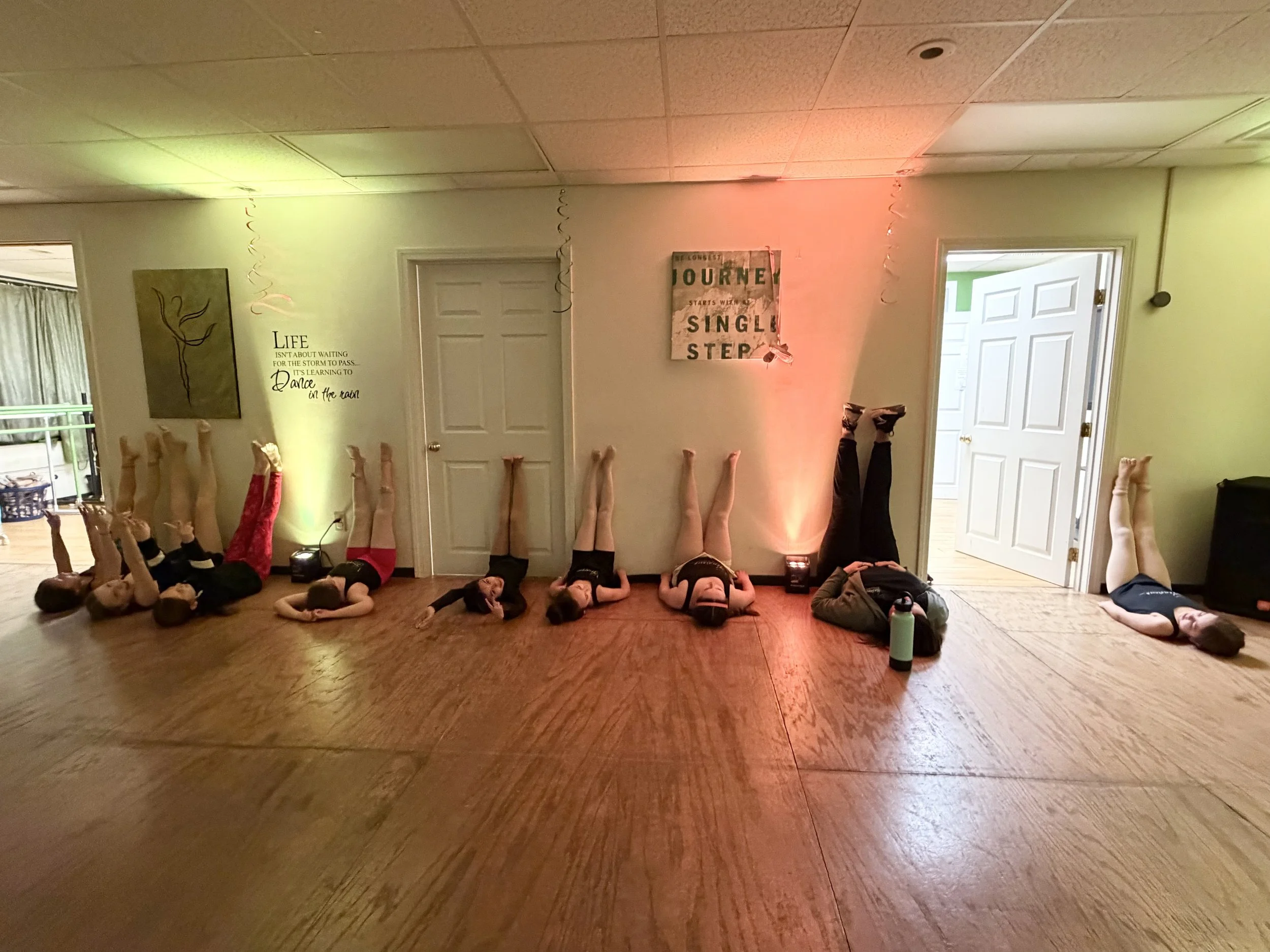
Ending class with Legs up the Wall and diaphragmatic breathing to reset our nervous system before leaving.
💜 How do I connect with myself?
Especially on Hard days…
Offering yourself compassion isn’t about doing less. In fact, research shows that when the nervous system is regulated and perceives safety, physical performance, motor learning, and recovery all improve (Porges, 2011; Thayer & Lane, 2000).
This has been a challenging piece of my health journey. I often find myself disappointed and frustrated when I feel set back or run into a challenge. Offering self-compassion is so important every day, but critical on hard days. Recently, I’ve been intentional in leaning into compassion and letting my body tell me what it needs.
One of my favorite quotes by Viktor E. Frankl reads, “Between stimulus and response, there is a space. In that space is our power to choose our response. In our response lies our growth and our freedom.”
This quote is on the wall beside my bed, so I see it when I wake up every morning. I start my day by asking myself: “Hey body, how can I meet you where you're at today?” The answer is different every time, but I’ve learned that when I ask my body what it needs and release judgment about the response, I create space for power, growth, and freedom.
✍️ Reflection Prompt: Pause & Notice
On your next hard day in the studio or life outside it:
What would progress look like if it were guided by compassion instead of pressure?
Where in your body do you feel tension or stress creeping in, and how could you notice it and offer your body an opportunity to tell you what it needs without judgment?
💜 Compassion in Practice
To encourage exploration with self-compassion, we practice these often in the studio at Illusions Academy:
Adjusting expectations instead of forcing perfection: High self-criticism increases stress hormones like cortisol, which can impair coordination and learning. By practicing realistic, compassionate expectations, dancers reduce stress and support more efficient skill acquisition (Breines et al., 2015). I might shape my classes by asking: “How can we reach the goal without pushing the body and our nervous systems beyond their limits?” Pro tip 👉🏼 Include yourself in your “plans.” I unselfishly include myself and my staff in this equation when creating lesson plans and expectations!
Taking intentional breaks between tasks: Short pauses allow the parasympathetic nervous system to engage, promoting recovery, reducing fatigue, and supporting longer-term performance (Porges, 2011). As an educator, I create opportunities for students to reconnect with their bodies, something many of us have grown disconnected from. When creating class structure, I ask myself: “Where can I intentionally build pauses or moments of awareness into my classes?” You can do the same thing when looking at your daily routine. Where can you intentionally pause and ask your body what it actually needs and respond without judgment?
Ending class with restorative poses (legs up the wall, somatic movements): Restorative positions and breathwork stimulate the vagus nerve, lower heart rate, and promote relaxation, allowing muscles to recover and the nervous system to return to a state conducive to learning (Thayer & Lane, 2000). The picture above is a great way to model compassion and connection to the self at the end of class. Pro tip 👉🏼 YOU, the adult, join in, because the kids/dancers love it when the teacher/adult has their legs up the wall! 🤣 This encourages curiosity, play, exploration, self-care, and more into one simple action. AND, we all know the adults need it too!
Choosing supportive self-talk: Even brief self-compassionate statements reduce physiological stress responses and improve focus, emotional regulation, and performance outcomes (Neff & Germer, 2013). Modeling positive self-talk and language encourages our children to do the same for themselves. If they see me offering myself compassion, they will learn to offer themselves the same.
💚 The Truth about Compassion
The truth is that educators, teachers, parents, grandparents, and… everyone deserves the same compassion that we offer the children and those we care for. Can we begin to feel curious about what it feels like to offer ourselves compassion, moments of pause, rest, and connection? Can we recognize that these are not signs of weakness, but signs of strength?…AND how cool is it that we, as adults, get to model this self-compassion and proper self-care for the next generation? 🫶🏼
✍️ Final Reflection Prompt: Connect with you
After your next class or hard day:
Spend 1–2 minutes lying on your back or sitting quietly.
Notice what it feels like when your nervous system registers safety.
Ask: What would my next step in training or life feel like if guided by regulation + compassion instead of pressure?
Notice one small moment today where you usually judge yourself.
Replace the criticism with one kind, factual statement.
How does your body respond to this? Breathing? Heart rate? Muscles? No judgment, just notice.
Stay tuned on the blog and follow @illusions_health for more Foundational Health tips for Dancers+ Women!
References
Neff, K. D. (2003). Self-compassion: An alternative conceptualization of a healthy attitude toward oneself. Self and Identity.
Breines, J. G., et al. (2015). Self-compassionate responses to failure reduce cortisol and perceived stress. Journal of Personality and Social Psychology.
Neff, K. D., & Germer, C. K. (2013). A pilot study and randomized controlled trial of the Mindful Self-Compassion program. Journal of Clinical Psychology.
Porges, S. W. (2011). The Polyvagal Theory: Neurophysiological Foundations of Emotions, Attachment, Communication, and Self-Regulation.
Thayer, J. F., & Lane, R. D. (2000). A model of neurovisceral integration in emotion regulation. Journal of Affective Disorders.