
Nervous System First: Why So Many Symptoms Are Connected
Migraines.
POTS.
Hypermobility.
Histamine issues.
Gut issues.
Chronic pain.
Anxiety.
Fill in the blank.
Often, these are treated like completely separate conditions. But many of them intersect at one shared system: the nervous system.
Whenever someone asks me about a symptom, I turn into a nervous system detective 🕵️😆 My first question is always: “How are you supporting your nervous system?” Over the past decade, both through my own journey and connecting with others, I’ve learned this lesson over and over: the nervous system is the foundation for everything happening in your body. This is not just “meditate” or “take some breaths”…it’s deep nervous system work. You can read more about my health and nervous system journey in my Health Story Blog. The nervous system isn’t asking to be “regulated” or “fixed”. It is asking to have a conversation with you and for your curiosity, exploration, movement, and connection.
Why the Nervous System Matters
The nervous system is the body's command center, regulating everything from movement and sensation to stress response and digestion. Your autonomic nervous system (ANS) quietly manages bodily functions such as:
✔️ Heart rate, blood pressure, and breathing
✔️ Digestion and gut motility
✔️ Pain perception and sensitivity
✔️ Muscle tone, posture, and joint stability
✔️ Immune and inflammatory responses (yes, including histamine)
✔️ Energy, recovery, and sleep rhythms
You can read more about the Nervous System in my blog here!
Did you know? 🧠
When your ANS is stressed, symptoms like pain, fatigue, or digestive issues can get louder, even if tests look normal. It’s not that your body is “broken,” it’s that your nervous system is protecting you.
(McEwen, 2007; Porges, 2011)
The Connection for Women and Dancers
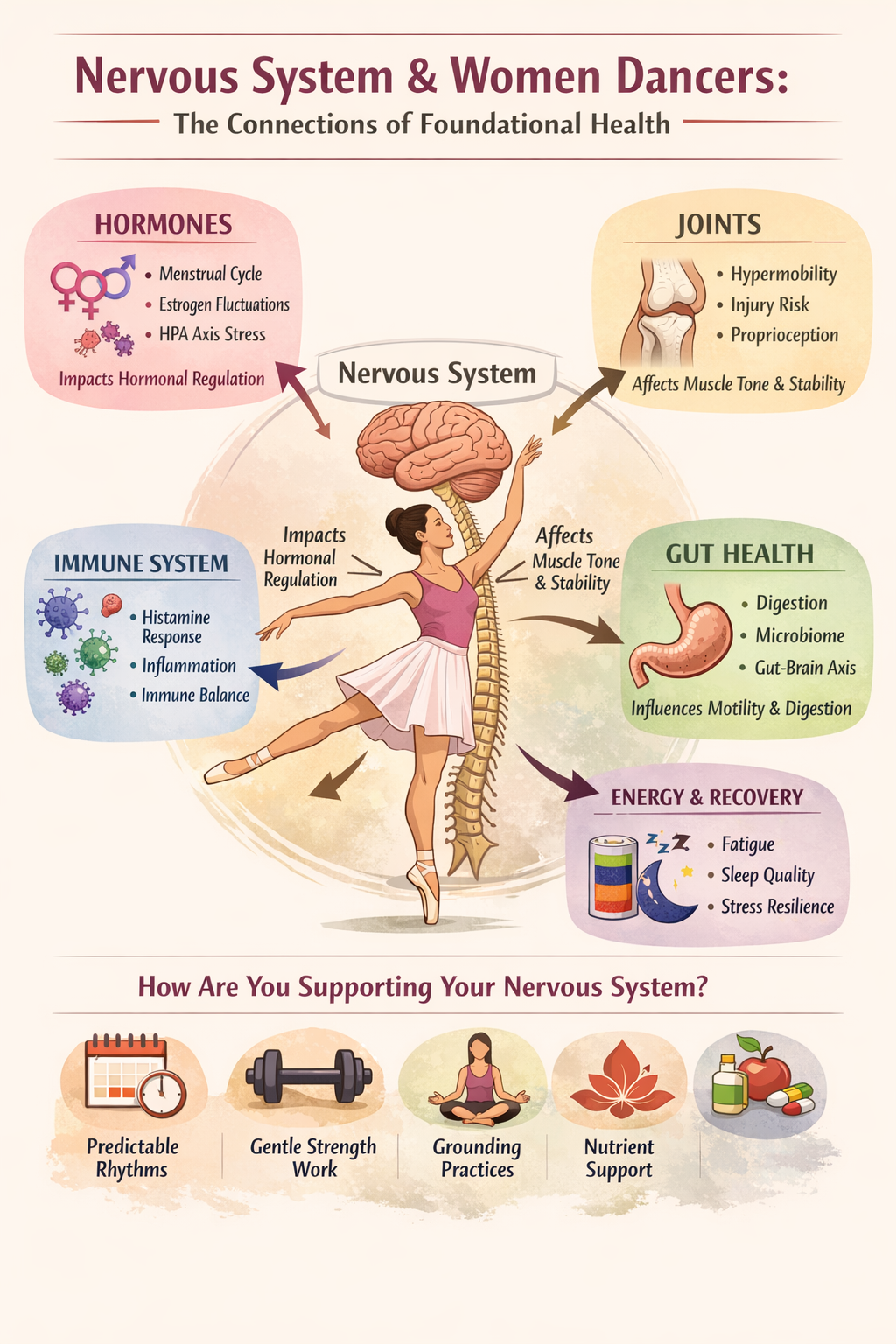
Your nervous system isn’t just about “stress” or “calming down.” It’s your body’s command center, regulating almost every system: movement, energy, digestion, immune function, sleep, and even emotional resilience!
For dancers, this system is constantly on the move. Every movement requires coordination, balance, and focus, all while your body manages signals of fatigue, tension, and recovery. Even outside the studio, your nervous system is responding to school, work, relationships, or environmental stressors! That is a lot to take on!
For women, the nervous system interacts with biological rhythms, hormones, metabolism, and structural support in ways that are often overlooked:
Joint stability & proprioception: Women often experience greater ligament laxity. A well-regulated nervous system helps coordinate muscles around joints, reducing the risk of injury and improving control.
Energy, fatigue & recovery: The nervous system manages how your body allocates energy for daily life and performance. Dysregulation can exacerbate fatigue or slow recovery.
Pain perception: How sensitive your body is to pain is filtered through your nervous system. When it’s in high-alert mode, even normal signals can feel amplified.
Digestive function: The gut is highly influenced by the nervous system. Stress or dysregulation can affect motility, nutrient absorption, and comfort.
Emotional regulation & anxiety: Your nervous system determines how your body responds to stress, fear, or performance pressure. This means heightened anxiety or nervousness can reflect nervous system load.
Your nervous system is constantly helping you perform with precision, endurance, and expression. Dysregulation can show up as fatigue, pain, digestive issues, or even anxiety. Recognizing the connection between all these systems can give you a place to start supporting yourself, instead of just “fixing” or chasing symptoms. (MacGregor, 2017; Schmandt et al., 2013) This is your body offering you a conversation and it is an opportunity to connect with your body on a deeper level.
💭 Sound familiar?
You get into class after a long day at school. You forgot your snack, and you’re still carrying a bit of anxiety from earlier. Suddenly 👉🏼 BOOM!—a headache hits as you start your first plie.
Of course it does! Your body is signaling that it needs support. Do this on repeat for a few days and before you know it… You have a cold!
We have all been there! BUT, a quick nervous system check-in can help! As you start class, and the headache hits, take a minute to reflect and ask yourself:
Did I hydrate and replenish minerals today?
Did I fuel my body with balanced, nourishing meals?
Did I give myself any time to pause and reset my nervous system?
If your answer is “No” to any of these, it might be a sign that your body + nervous system need gentle foundational support. Btw, you could answer “Yes” to all of these, and your nervous system might still need a “hug”!
Sometimes, simply stepping aside to grab a snack or a drink is the first step. It’s your way of telling your nervous system: “Stand down. You are safe. I am taking care of you.”
When your body senses safety, symptoms often reduce…or even disappear entirely!
✍️ Reflection: Becoming a Nervous System Detective:
Conduct your own “Dysregulation Audit”: Reflect on some ways you might notice dysregulation in yourself. Have you ever felt dysregulated and not realized that is what you were experiencing? What strategies did you use to support your nervous system to shift? Can you build yourself a toolkit of “go-to” strategies that work for your system to use when you need them?
💡 Did you know?
Hypermobile dancers often rely on their nervous system to stabilize joints and muscles. Supporting it can reduce fatigue and the risk of injury.
(Rombaut et al., 2011)
Gentle Ways to Support Your Nervous System
Supporting your nervous system isn’t about doing more; it’s about creating safety, predictability, and trust in your body. Think of it like giving your nervous system a gentle hug: letting it know, “I’ve got you, you don’t need to stay on high alert.” Nervous system support isn’t just offering quiet or stillness. It’s allowing whatever is there to be and learning to build a relationship with yourself.
I always recommend starting with the foundations, or the small, daily practices that set the stage for everything else.
My Foundations of Health Course, designed for dancers and women, elaborates on how the following foundations support overall health and well-being.
Start with these 👉🏼
Nervous System
Circadian Rhythm
Sleep
Hydration + Minerals
Metabolic Health
Detoxification + Drainage
Social + Spiritual Connection
Mental Health + Emotional Wellness
Movement + The Fascia
Functional Nutrition
In your day-to-day, this might look like:
✔️ Stable routines: Consistent sleep, meals, hydrating with minerals, and supportive movement.
✔️ Gentle strength & fascia movement: Movement that improves stability, flexibility, lymphatic flow, and strength without overtaxing your body.
✔️ Grounding practices: Somatic exercises or mindful stretching to support the nervous system.
✔️ Nutrition: Full + well-balanced meals, gut-supportive foods that you enjoy.
✔️ Hormonal awareness: Track your menstrual or cycle phases to match training, rest, and recovery.
💡 Did you know?
Even small, predictable habits, like a 5-minute grounding breath sequence, a few gentle stretches before bed, or a short body scan, can send a message of safety to your nervous system. When your nervous system perceives safety, it’s better able to regulate heart rate, digestion, pain perception, and stress responses (McEwen, 2007; Porges, 2011). These simple practices don’t need much time, but consistency is key. Over days and weeks, your nervous system learns new patterns of safety.
🧠 Give it a Try
5 slow, deep breaths with legs up the wall before sleep
Gentle neck and shoulder rolls to release tension and encourage lymphatic flow
Mindful presence, noticing your body’s contact with the floor or chair
A short gratitude or grounding reflection before starting your day
A morning walk or somatic exercise to start the day.
Even these tiny actions can make a big difference over time, helping reduce pain, anxiety, fatigue, digestive upset, and other symptoms, while supporting overall performance and well-being.
✍️ Dancer Reflections
A grounding breath, a few gentle stretches, legs up the wall, or a snack can be more effective than pushing your nervous system through. This small shift in perspective can change everything, from symptoms to energy to performance!
Instead of asking, “What else should I fix?” try: “How can I connect with myself to encourage conversation with my body?”
If you’re rehearsing tough choreography or recovering from a long day, pause and ask: “How can I support my nervous system in this moment?”
How might this perspective support my growth as a dancer?
Stay tuned for more foundational health tips for dancers and women, and more information on my upcoming Nervous System Group Course and my Foundations of Health Group course!
📚References
McEwen, B. S. (2007). Physiology and neurobiology of stress and adaptation. Physiological Reviews, 87(3), 873–904.
Porges, S. W. (2011). The polyvagal theory: Neurophysiological foundations of emotions, attachment, communication, and self-regulation. Norton.
MacGregor, E. A. (2017). Migraine in women: Clinical perspectives. Headache, 57(2), 221–232.
Schmandt, R. E., et al. (2013). The impact of reproductive hormones on women’s health. Endocrine Reviews, 34(5), 533–585.
Rombaut, L., et al. (2011). Musculoskeletal complaints, physical activity, and quality of life in hypermobile women. Arthritis Care & Research, 63(12), 1741–1749.