Widening the Lens on Movement: A Part of Your Story
As my Performance Company enters a series of competitive events, a season of structure, rehearsal, preparation, and evaluation, I find myself wanting to widen the lens. Dance exists in many forms, across many pathways and seasons. Some ask for precision, uniformity, clean lines, timing, and technical excellence, while others invite a different approach. These seasons build self-compassion, discipline, focus, connection, teamwork, and the ability to refine and grow. These pathways matter because they are part of the process of developing strong, capable dancers.
Competitive dance is one pathway, but it is not the only way to grow as a dancer. You do not need to compete to develop strength, skill, or artistry. Both of these truths can coexist. For me, competitive dance brought experiences I will always treasure, including artistic growth, joy in movement, world travel, connection with teammates and mentors, and the opportunity to refine my skills while being challenged to push myself. When I think back on those years, I don’t remember my mistakes. I remember the joy. I remember the experiences. I remember feeling alive and free inside my body. That is what stayed with me for decades to follow. These experiences were invaluable, forming just one part of my story as a dancer, yet they are not unique to competition. They can be found in many forms of dance, movement, and creative exploration. It is my view that competitive dance is one among many movement experiences, and all pathways have value.
Other pathways invite us to listen, to sense, and to respond, encouraging movement that arises from within rather than being prescribed from the outside. They call for fluidity, organic expression, individuality, and the courage to move without needing to match anyone or anything. These pathways are not separate but interconnected, and there is not one right way to move. We are all born movers, long before we are trained dancers. I want to be clear: competitive dance is not the opposite of embodiment. At its best, it depends on it. A dancer can be technically precise, but without presence, the movement feels empty. Understanding how these paths intersect and dance with one another has profoundly shaped the way I approach movement and dance education today.
Now, as a mover and educator at this stage in my life, I have been learning to live somewhere in the middle, in the gray space between structure and exploration. Sometimes movement can simply be movement. Not for a score. Not for a correction or analysis. Not for an audience. Not to achieve, perform, or perfect. Movement for the sake of moving. For the experience of being present and alive inside a body. For expression, for release, for joy. There is value in that space without needing it to become anything more. There is also space for structure and evaluative movement, for discipline, refinement, and intention. Both spaces hold value depending on your intentions.
In competitive environments, it can be easy to internalize the idea that being evaluated means being defined, that scores tell the whole story, or that technique is the ultimate measure of a dancer’s worth. It is important to remember that these measures do not define you. Judging panels evaluate specific criteria within a framework. Their guidelines are not the full picture of dance, your history, or your future as a mover or artist. Their role is to respond to a performance through a particular lens on a particular day, not to measure your creativity, your spirit, or the totality of your artistry.
That evaluation is only one piece of your story.
If you need a reminder throughout the upcoming events, remember that movement lives in exploration, somatic practices, cultural and social forms, competitive spaces, creative movement classes, rehearsals, healing spaces, and living room dance parties with friends. It also lives in ocean waves, flowers, trees, animals, open backyards, and in the quiet rhythm of your breath.
Dance can be technical and expressive, precise and artistic, disciplined and therapeutic, grounding and expansive. It can hold structure and freedom at the same time. It can be many things at once and whatever you need it to be on any given day.
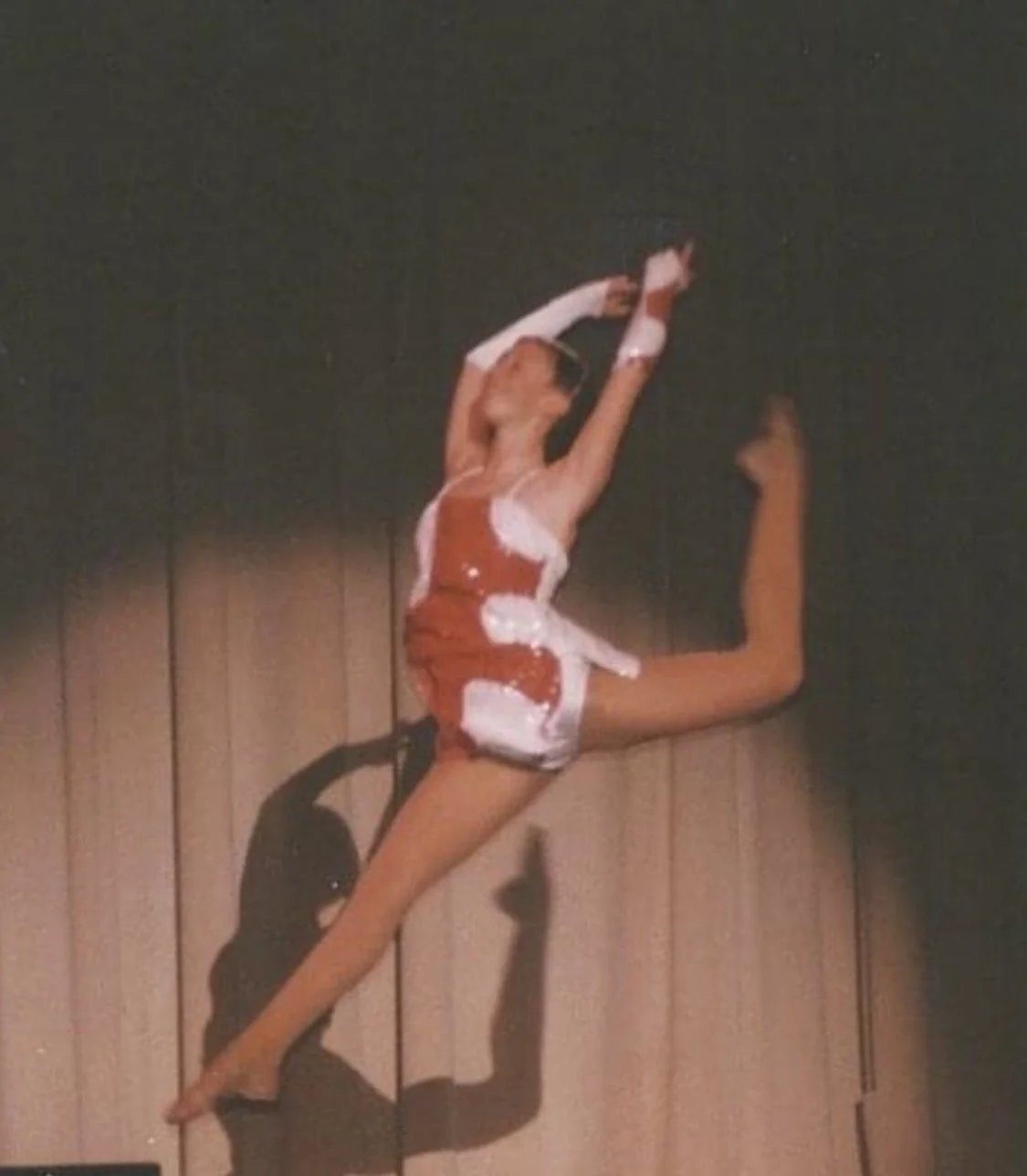
Younger me, in all her competitive solo glory.
At Illusions Academy, we honor all that dance and movement can be. We train for precision and rehearse for excellence while respecting and pursuing our goals. We also cultivate awareness, curiosity, embodiment, compassion, and connection. We recognize that all these pathways coexist and overlap. For us, there is no single right way to move or a single pathway to follow. Some seasons ask for structure. Some seasons ask for exploration and curiosity. Some seasons ask for both.
And all of it becomes part of your story.
As we enter the upcoming events, I wanted to share a few things the younger version of me pictured above needed to hear, and something I hope our dancers can carry with them as well. What I would say to my younger dance self, and to each of you, is this: take a moment to notice and appreciate the value in your experiences, the pride in your growth, the joy in movement, the lessons learned, and the connections made as an individual and as part of a team. Remember that every rehearsal, every performance, and every challenge is part of your journey. There is value in wanting to succeed. There is value in preparing with intention and working toward a win. There is also value in moving for the joy of moving. Let your desires shift with the seasons while strengthening your focus and your presence.
You are more than your score. More than your placement. More than one day on stage. You are an evolving artist. And before any of that, YOU are simply a human who moves.
“Since the dawn of time, humans have been dancing. There is no deleting feelings or stories within your body; they live within you. A way to process and understand those stories, those feelings, those sensations is to dance with them. ”